Triangular Alopecia in Females: A Case Study and Recovery with Dr Ahsen
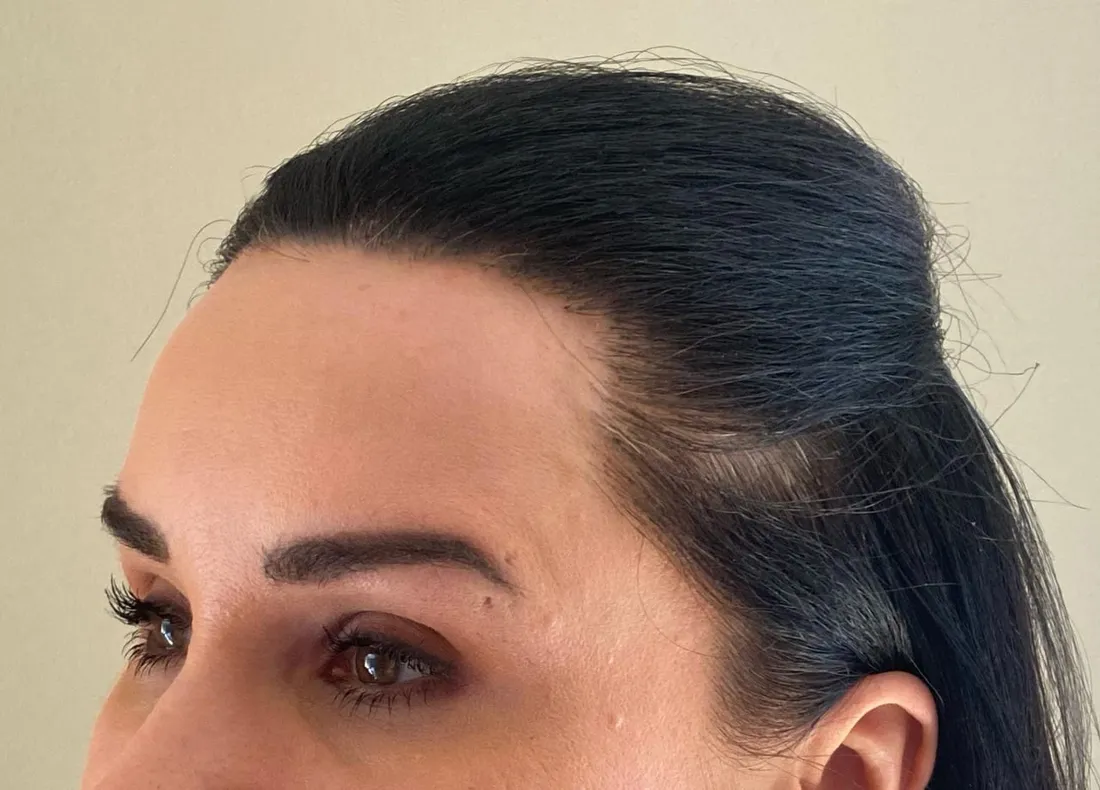
A real case study of temporal triangular alopecia in a young woman, and how Dr Ahsen restored her hairline naturally using the FUE technique.
Imagine noticing a distinct, triangular patch of hair loss on the side of your head. That is exactly what happened to one of our patients, and her story is both informative and encouraging. Hair loss affects many women’s confidence and wellbeing, and triangular alopecia in particular can be distressing, especially for younger women.
Understanding triangular alopecia
Temporal triangular alopecia usually presents as a well defined, triangular area of hair loss on one side of the scalp. It often appears in childhood and can persist into adulthood. Unlike some other forms of alopecia, it is not caused by an autoimmune response and is believed to be a hereditary condition. The exact cause is unknown, but it primarily affects females.
The patient’s concern
Sarah, aged 28, was confident and stylish with a full head of hair. Then she began to notice thinning on one side of her head, gradually forming a triangular shape. Understandably, it affected her confidence. She tried over the counter treatments and different hairstyles, but nothing worked, so she decided to seek professional help.
The consultation
At the initial consultation, Dr Ahsen examined her scalp thoroughly and explained that triangular alopecia, while challenging, can be treated effectively with a hair transplant. He talked through the two main techniques:
- FUE (Follicular Unit Extraction): individual follicles are extracted from the donor area and implanted into the recipient area, known for precision and minimal scarring.
- DHI (Direct Hair Implantation): follicles are implanted directly, giving even greater control over the direction, angle and depth of each hair.
After weighing the pros and cons, Sarah and Dr Ahsen decided that FUE was the most suitable option for her case.
The FUE procedure
Local anaesthetic was applied to the donor and recipient areas for a comfortable, painless experience.
- Donor preparation: the donor area at the back of the scalp was prepared, and individual follicles were carefully extracted with a micro punch and sorted so only the healthiest grafts were used.
- Recipient preparation: tiny incisions were made in the triangular area, following the natural growth pattern.
- Implantation: the follicles were implanted at the correct angle and depth to mimic natural growth.
Aftercare
Sarah received detailed post operative instructions: keep the scalp clean with the prescribed solution, sleep with the head elevated for the first few nights, protect the scalp from direct sunlight, take any prescribed medication, and avoid washing the hair for the first 48 hours.
The outcome
Sarah’s story is a reminder of how effective hair restoration can be. Triangular alopecia can be distressing, but it is not without hope. With an experienced surgeon and techniques like FUE and DHI, patients can restore their hairline and their confidence. If you or someone you know is dealing with triangular alopecia, a consultation with a hair transplant expert is the best first step.

Written by
Dr Ahsen Farooque
MBBS, MD, ABHRS (USA). Diplomate of the ABHRS (USA), DHI Master Specialist and DHA-licensed hair transplant surgeon in Jumeirah, Dubai.